
About us
MinorsFriendly supports communities and projects that work with children and young people in developing and implementing safety standards. Our goal is to help organizations active in education and youth development to create spaces where young people can thrive in an atmosphere of trust, respect, and responsibility.
In our work, we aim to combine an attitude of trust and closeness with a high level of professionalism. Protecting minors is not just about creating procedures. It’s also about building a culture of relationships based on responsibility, transparency, and concern for the well-being of every individual. That’s why we emphasize the importance of the formation of those who work with young people: educators, volunteers, leaders, and everyone involved in educational and formative activities.
In developing materials and standards, we draw on the expertise of lawyers, psychologists, educators, and pastoral workers. This ensures that the proposed solutions are both legally sound and appropriate for real-life educational situations. We also strive to incorporate best practices from around the world and the experiences of institutions that have been working for many years to create safe environments for children and youth.
Since many initiatives today operate in an international context, we take into account the specific laws of each country as well as to the local guidelines of the Catholic Church. This allows us to adapt our proposed standards to the specific legal and cultural realities of each place while maintaining consistency in the fundamental principles of child protection.
Transparency and the ability to verify how solutions have been implemented are also key elements of our work. Creating safe environments requires not only good intentions but also clear procedures, proper documentation, systematic training, and continuous improvement of practices. That’s why we support initiatives aimed at developing specific tools: action protocols, training programs, guidelines for cooperation with institutions, and accountability mechanisms.
At the same time, we emphasize the need to properly distinguish between legal and organizational responsibility. Amid the numerous social and educational initiatives in our societies, diverse entities often collaborate: families, associations, schools, and church institutions. Clarity in defining roles and responsibilities helps build trust, protect participants, and ensure appropriate standards of conduct.
Our website features a publicly accessible section available in ten languages. It contains both general principles for the protection of minors and specific guidelines tailored to individual countries (including information on applicable legislation, institutions, and procedures).
The Spanish and English versions are general in nature and serve as models. Meanwhile, registered institutions or initiatives—like schools, clubs, and pastoral ministries—can access more detailed materials: training plans, monitoring systems, certificates, and other tools to support the implementation of child protection standards.
The website operates in full compliance with personal data protection regulations.
The same is true for partner institutions.
Action Plan
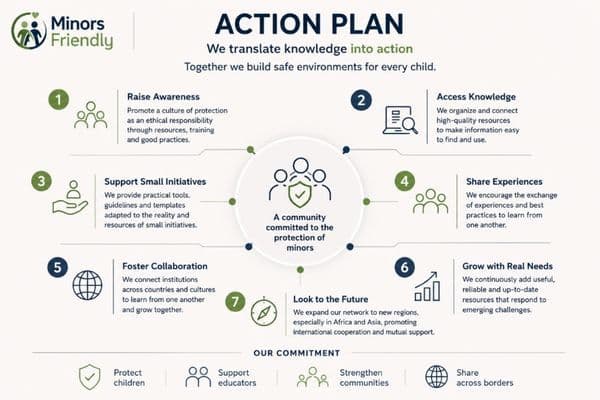
The protection of minors does not depend solely on having good policies in place. It requires building a genuine culture of care, training people, sharing experiences, and providing tools to help put that culture into practice. MinorsFriendly was founded on the basis of this conviction, and our plan of action is built on this idea.
1. Raising Awareness and Fostering a Culture of Protection
The first step is to help people understand that protecting minors is not an administrative obligation or a response to legal requirements, but rather an ethical responsibility that’s part of the mission of every educational, social, sports, cultural, and religious institution.
This is why MinorsFriendly brings together articles, studies, documents, training materials, glossaries, audiovisual resources, and best practices that help grasp the importance of creating safe environments. We want to offer a broad view of the topic, helping people understand not only what to do when a problem arises, but also how to prevent problems through an appropriate institutional culture.
Awareness is the foundation of any lasting change. Only when people understand the value of child protection can they responsibly engage in promoting it.
2. Facilitating Access to Existing Knowledge
The Internet contains a vast amount of high-quality resources on child protection. However, many institutions struggle to find, evaluate, and select those that truly meet their needs.
Our goal is not to duplicate the excellent work already being done by numerous organizations, universities, public administrations, and specialized entities. On the contrary, we want to become a hub that facilitates access to these resources by organizing, categorizing, and presenting them in a clear and accessible manner.
MinorsFriendly aims to be a gateway to existing knowledge, allowing anyone to easily find the information they need to advance child protection.
3. Providing Special Support to Small Initiatives
Many institutions have specialized departments, legal counsel, and teams dedicated to these issues. But a lot of educational, sports, social, and pastoral initiatives are small and do what they do only thanks to the commitment of individuals with limited resources.
It is precisely these initiatives that often face the greatest difficulties in developing protocols, organizing training, assessing risks, and keeping their protection policies up to date.
That’s why one of MinorsFriendly’s priorities is to offer practical, simple, accessible assistance. We aim to provide templates, guidelines, examples, adaptable materials, and resources that make it possible to put effective protection systems in place without a need for large structures.
Our goal is to bridge the gap between large organizations and smaller initiatives that want to do things right but need support to be able to do that.
4. Sharing Experiences and Learning from One Another
Experience shows that many of the best solutions arise from the everyday work of people and institutions facing similar challenges.
For this reason, MinorsFriendly also aims to become a platform for sharing experiences. We do not intend to only offer documentation, but also to encourage the dissemination and sharing of best practices and their adaptation to different contexts.
Every institution that finds an effective solution can help many others. Sharing knowledge prevents the repetition of mistakes, accelerates learning, and helps build a real community committed to protecting minors.
5. Fostering International Collaboration
One of the defining features of MinorsFriendly is its international scope.
The platform enables resources, experiences, and materials to be shared across languages and cultures. Many institutions work in isolation even though they face very similar problems. Facilitating knowledge-exchange multiplies the opportunities for learning from one another.
This collaboration is especially valuable for places where there are few educational initiatives inspired by a Christian view of the person and where those in charge have limited resources to develop their own protection policies.
6. Growing Together With the Real Needs
MinorsFriendly is a project in constant development. Child protection is constantly evolving, as new challenges arise and new responses emerge that need to be incorporated.
Thus, the platform will continue to grow with the addition of new resources, tools, experiences, and training materials. Our goal is not to accumulate information, but to offer contents that are useful, reliable, and easily applicable.
We want each new resource to address a specific need and help improve the daily work of those responsible for caring for children and young people.
7. Looking to the Future
In the coming years, we hope to gradually expand this collaborative network to more regions of the world.
A variety of institutions in countries of Africa and Asia have already expressed interest in taking part. In many of these countries, we find a very similar reality: numerous small initiatives, tremendous personal commitment, and difficulties accessing specialized resources or maintaining stable protection programs.
Our aspiration is for MinorsFriendly to be a space for international cooperation through sharing experiences that can help others, while always respecting the cultural and legal realities of each country.
We believe protecting minors is a shared responsibility that transcends borders, languages, and cultures. When an institution improves its protection systems, it also contributes to the learning of many others. And when best practices are generously shared, all children benefit.
That is, ultimately, the vision of MinorsFriendly: to build an international community of learning, collaboration, and mutual support so that more and more institutions can offer environments that are truly safe, respectful, and centered on the dignity of every child and adolescent.
Our Sustainability Model
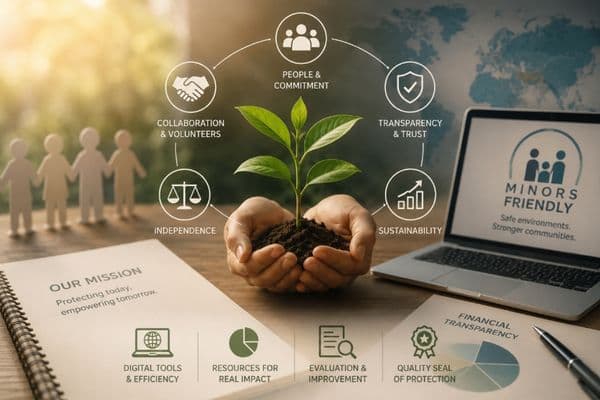
MinorsFriendly was established thanks to the commitment and generosity of many people who share a common goal: to help make institutions increasingly safe for minors. Professionals from various fields, educators, experts, and volunteers dedicate their time, experience, and knowledge to advancing this project, convinced of the importance of fostering a genuine culture of protection.
Precisely because so many people participate on a volunteer basis, MinorsFriendly is able to maintain a lean and flexible structure. We do not have a lot of infrastructure or organizational complexity. Our working model is based on collaboration, knowledge-sharing, and leveraging the possibilities offered by digital tools, which allows us to significantly reduce operating costs.
The project’s financial resources mainly go to maintaining the platform, developing new tools, translating and updating content, providing technical support, and coordinating the individuals who contribute on a regular basis to the initiative.
From the start, we’ve sought to preserve the project’s independence. Our goal is thus to build a sustainable funding model that does not rely on public subsidies or place a financial burden on the Church or institutions that are already making significant efforts in education and training.
As MinorsFriendly grows, we will periodically publish information about the use of financial resources and the project’s main costs. We believe that transparency is essential for building trust and ensuring responsible management.
At a later stage, we plan to offer institutions a service for the assessment, monitoring, and continuous improvement of their child protection policies. This service will include review and support processes tailored to the specific characteristics of each organization and will be subject to a fee that will help sustain the platform’s development.
Our aspiration is for MinorsFriendly, over time, to become a recognized benchmark for quality and commitment to child protection. We want the name of MinorsFriendly to represent a guarantee of best practices, something to be achieved not with marketing, but with a natural prestige earned through diligent work, professional competence, transparency, and the trust that institutions place in our project.
We believe the best way to secure MinorsFriendly’s future is to build an economically sustainable, independent, and service-oriented model. In this way, we’ll be able to help a growing number of institutions and, with them, contribute to creating increasingly safe environments for all children and adolescents.
Protecting also means documenting
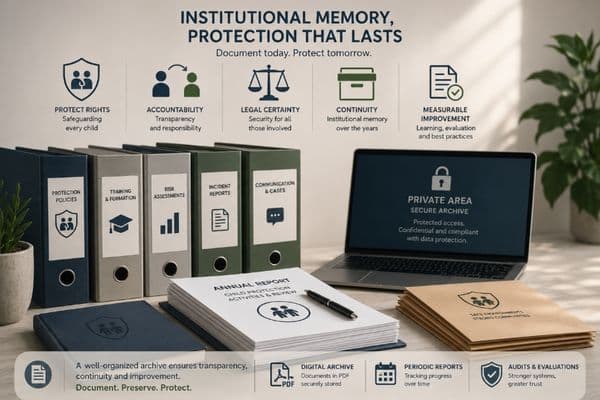
The protection of minors does not depend solely on having good protocols in place. It also requires a solid institutional memory capable of preserving the information necessary to ensure continuity, transparency, and continuous improvement in our actions.
Each annual report is an exercise in truth and accountability. At the same time, it is a tool for hope and prudence, because it allows us to learn from experience, identify areas for improvement, and avoid both improvisation and superficiality in a matter of such importance.
For this reason, MinorsFriendly promotes a genuine culture of record-keeping. The orderly and secure preservation of documentation over long periods of time is not merely an administrative task, but an essential part of any protection system. Maintaining a documentary record ensures the continuity of projects, facilitates periodic evaluations, and guarantees that best practices do not depend solely on the individuals currently holding specific responsibilities.
Furthermore, a well-organized archive serves as an important legal safeguard for all those involved. It protects the rights of minors, facilitates the clarification of facts when necessary, and provides security for both victims and those engaged in educational, formative, pastoral, and support roles. Having complete, chronological, and verifiable documentation contributes to transparency, upholds the right to defense, and avoids decisions having to be based solely on memories or incomplete testimonies.
An institution that properly documents its actions better protects individuals and strengthens trust in its procedures.
For this reason, the platform provides institutions with a secure, private, restricted-access space where, under the protection of login credentials, each organization can systematically store its documents, protocols, reports, and other materials related to the protection of minors, always in compliance with data protection regulations and respecting the confidentiality of sensitive information.
The system additionally facilitates the periodic preparation of reports and the archiving of documents in PDF format, creating a complete documentary record of the actions taken. This institutional record serves to document the work carried out over time, facilitates audits and evaluations, promotes continuous improvement, and provides a solid foundation for accountability.
In short:
Archiving is not just about preserving documents. It means protecting rights, preserving institutional memory, providing legal certainty, and ensuring that commitment to child protection remains alive and verifiable over the years.
A Culture of Trust
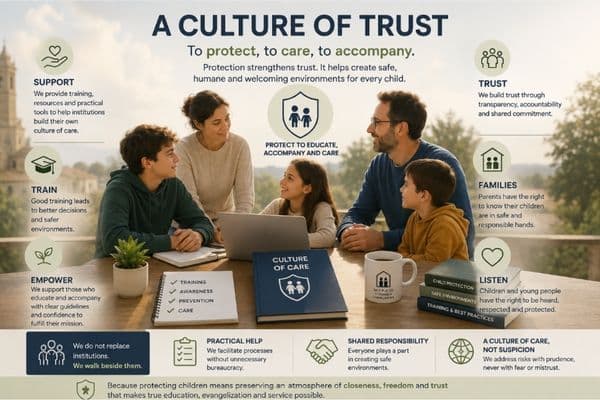
The protection of minors stems from trust and is meant to strengthen trust. Its purpose is not to create a climate of constant suspicion, but to help ensure that educational, pastoral, and social institutions become increasingly safe, humane, and welcoming places.
MinorsFriendly does not seek to replace the responsibility of institutions or become a regulatory body. Its mission is to provide support, offer tools, share best practices, and facilitate processes that help each organization develop its own culture of care.
We believe that the best prevention begins with good training. Thus the project’s main objectives include raising awareness, providing training, and offering practical resources to educators, priests, catechists, volunteers, coaches, families, and those in charge of institutions.
Well-trained people make better decisions and create safer environments.
All of this must be done without unnecessary bureaucracy or demands that end up stifling educational or apostolic initiatives. Protection cannot become an obstacle to education, evangelization, or service to others. On the contrary, it must help these activities unfold with greater peace of mind, quality, and safety.
We start from a deeply human conviction that the vast majority of those who dedicate their time to educating, accompanying, or forming young people do so out of a genuine vocation to service. They deserve support, training, and tools—not a constant presumption of mistrust. An institution that cares also cares for its educators, offering them clear guidelines, appropriate procedures, and the security necessary to carry out their mission well.
At the same time, trust must extend to families and to the children themselves. Parents have the right to make sure that their children are participating in activities conducted in accordance with objective standards of protection. Children and young people need to feel that institutions are prepared to listen to them, respect them, and take action when necessary. Trust is not born of statements, but of actions, transparency, and consistency.
A culture of care must not become a culture of suspicion
That is why MinorsFriendly aims to help create a genuine culture of trust: a trust built on training, accountability, transparency, and shared commitment. A trust that does not ignore risks, but that also does not allow fear to replace education, nor suspicion to replace human relationships. Because protecting children also means preserving that atmosphere of closeness, freedom, and trust that makes true educational work possible.
The People Who Make MinorsFriendly Possible
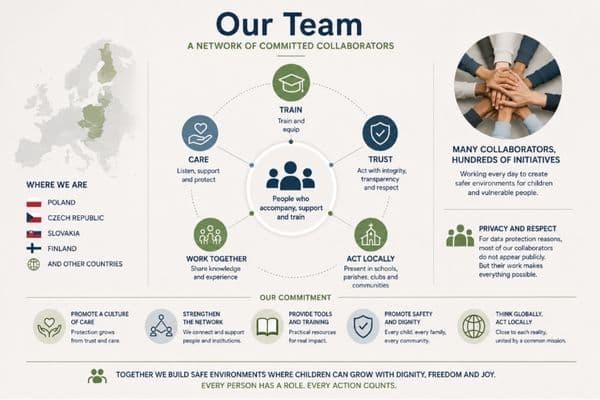
As mentioned, MinorsFriendly is an initiative driven by people who are convinced that the protection of minors is a shared responsibility. Behind this platform are professionals and volunteers from diverse fields—education, law, psychology, communications, pastoral work, institutional management, and new technologies—who contribute their expertise toward a common goal: to help create increasingly safe environments for minors and vulnerable people.
The initiative originated in Central Europe, and as a result, the main coordination efforts are based in the countries where the platform is currently active. On our website, you can find the key contacts for the various language and national versions—Poland, the Czech Republic, Slovakia, Finland, and the other countries where MinorsFriendly operates—as well as other collaborators who are directly involved in the project.
But the people who appear publicly represent only a small part of this reality. The true strength of MinorsFriendly lies in the hundreds of collaborators who work every day in schools, parishes, associations, sports clubs, youth movements, foundations, and many other educational and social institutions.
For reasons of privacy and data protection, the vast majority of these collaborators do not appear on this page. Yet it is they who make it possible for the culture of care to translate into concrete actions: training others, implementing protocols, listening, providing support, preventing risks, and creating spaces where children, adolescents, and families can feel safe.
This approach reflects a fundamental aspect of the Church’s social doctrine: the principle of subsidiarity. The protection of minors cannot be built solely by central agencies or through general regulations. It must take root where children and young people live, grow, and interact – in the family, at school, in the parish, at the sports club, in educational institutions, and in every local community.
The mission of MinorsFriendly is precisely to strengthen this network of people and institutions by offering training, tools, and support so that each can assume its own responsibility. Because safe environments are not built from an office, but rather through the daily commitment of thousands of people who educate, accompany, and serve with professionalism, generosity, and compassion.
MinorsFriendly is not just a platform. It is a collaborative network in which many people from different countries and disciplines work together to make child protection a concrete reality where it matters most: close to every child, every family, and every community.
We hope that MinorsFriendly will become less and less necessary over time. Our greatest success will be when child protection no longer depends on a few specialists but is embraced as a shared responsibility by the entire educational and social community. That is why we want to identify, train, and support new collaborators who are capable of fostering this culture of care wherever they live and work. Because a society truly protects its children when every person understands that they, too, have an irreplaceable role to play in that mission.